It's time to know who you are really voting for.
Every U.S. senator, measured on the same public record — integrity, effectiveness, and where they truly stand. The receipts, in one place.
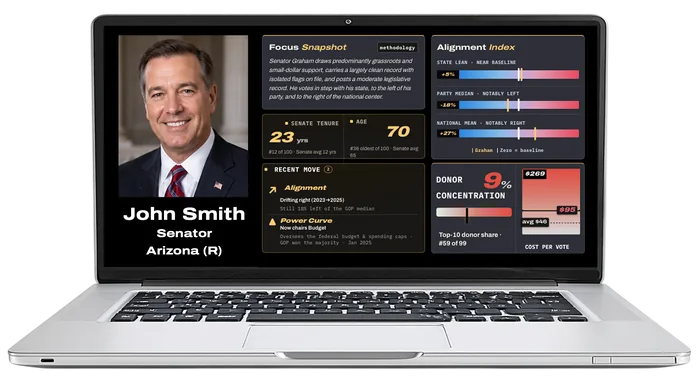
Every U.S. senator, measured on the same public record — integrity, effectiveness, and where they truly stand. The receipts, in one place.
Politics runs on money, influence, and votes — but the receipts are scattered across a dozen government databases nobody reads. Focus Report pulls them together. The Senate, the House, the executive branch — scored on Integrity, Effectiveness, and Alignment using nothing but the public record: campaign finance filings, voting history, financial disclosures, legislative output. No pundits. No spin. No accusations — just the math, shown.
In this arena, a picture really is worth a thousand words. A single chart can reveal what a hundred news cycles bury — who funds whom, who shows up, who delivers. Focus Report lays it all out in clean, easy-to-read visuals anyone can understand in seconds. We don't tell you who the good guys are. We show you what the data says and let you decide. That's the shift: from being told what to think about power, to seeing exactly how it works.
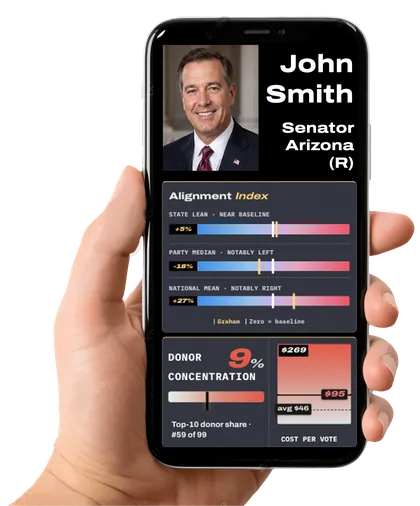
No marketing asterisks, no per-senator adjustments. One open methodology, applied identically to all 100.
How closely a senator's record tracks their constituents, their party, and the national interest — measured from roll-call votes.
Conflicts, disclosures, donor concentration, and adjudicated ethics findings — the conduct behind the votes.
What they actually move — bills advanced, coalitions built, and results delivered in office.
Every score traces back to the record. Open formula. Free at the surface, subscriber-supported where the work goes deepest.
Focus Report is an independent accountability platform covering all 100 U.S. senators, built entirely from what the public record shows — not opinion, not punditry, and not a popularity contest. We pull from the government's own filings — campaign-finance reports, financial disclosures, the Congressional record, Senate Ethics actions, lobbying registrations — and turn them into clear reads you can take in at a glance and trace back to the source.
There is no overall score — no single 1-to-100 verdict, no ranking of senators against each other as people. We think a number like that would be the least honest thing on the page. Instead each dimension is measured on its own terms, using the instrument the record can actually support:
Funding — who bankrolls them — and Integrity — conduct and rule-compliance in office — are rated, because filings document them directly. Senate power is ranked rather than rated: committee seats, gavels, leadership posts and seniority are published positions, so they can be placed in an order. Legislative effectiveness is deliberately not scored at all — crediting a law to one senator is a causal claim, and the Senate's own record cannot support it. We show what a senator got onto the books beside the power their seat gives them, and let you read it. Alignment — where their votes place them — is descriptive and never scored in any direction.
Where the record can't support a fair measure, a dimension stays unrated rather than becoming a low mark. Our north star: measure what a senator can control and is accountable for, and be honest about everything else. We show; we don't accuse.
Because "left or right" and "honest or effective" are two different questions, and most scorecards quietly answer the first while claiming to answer the second. If a rating goes up when a senator votes your way, it isn't measuring conduct — it's measuring agreement.
So we split them. A senator's positions live in Alignment, which is descriptive and never scored.
That's what makes the ratings usable by someone who disagrees with you. Your politics are yours. We just show the record.
From the roll-call record — every vote a senator has cast — placed using the political-science standard for locating legislators on the spectrum. On our map, left-to-right is lean and up-to-down is independence, so you can see both how far a senator sits from center and how often they leave their party to get there.
We then measure that position against three baselines: their state's lean, their party's median, and the national mean. Read together they say more than any one alone — a senator can sit deep in their party's wing and still be closer to their state than most of their colleagues.
On specific issues we only count votes the Senate actually held cleanly, on one subject. The biggest fights often happen inside omnibus packages that bundle dozens of unrelated topics into a single yes-or-no, and a vote there can't honestly be pinned to any one issue — so we leave it out rather than guess. Where the parties genuinely split among themselves, we flag it as a party split instead of pretending one position exists.
Entirely from primary records of conduct in office: conflicts of interest between a senator's own finances and the industries their committees regulate; stock-trading activity under the STOCK Act, including timing; the timeliness and completeness of required financial disclosures; lobbying and revolving-door ties; and any formal Senate Ethics findings. Serious, adjudicated ethics findings act as a hard ceiling on the rating — as they should.
Crucially, a top score is not "we didn't find anything." Clean is earned, not avoided.
And we document rather than accuse. That a senator's holdings overlap the industry their committee oversees is a fact we can show you. Whether it changed a vote is a conclusion, and that one is yours to draw.
It's one of the three rated dimensions, and for a brand-new senator it's often the only part of the record that exists yet — you can't have a legislative history on day one, but you can already have a donor base.
We show a senator's money-source exposure: how much comes from in-state, small-dollar, grassroots giving versus out-of-state industry money, PACs, mega-donors, and dark money. Deliberate choices get credit — refusing corporate PAC money, taking a no-PAC pledge, building small-dollar support.
Two pools sit behind every figure, and they follow different rules. Money given to a campaign is capped by law and disclosed by donor. Money spent for a campaign independently is uncapped and often untraceable to a person. We show both, drawn from FEC filings across a trailing six-and-a-half-year window, and we're explicit that these totals are a floor, not a ceiling — giving we cannot document doesn't get counted.
Because in this arena a picture really is worth a thousand words. A single chart can reveal what a hundred news cycles bury — who funds whom, who shows up, who delivers.
The underlying records are real but nearly unreadable: thousands of FEC line items, disclosure forms scattered across a dozen government databases nobody reads, roll-call votes stretching back decades. Handed to you raw, that isn't transparency — it's a wall. Turned into a slider and a chart, it's an answer you can reach in seconds and still trace back to the filing behind it.
That's the shift: from being told what to think about power, to seeing exactly how it works.
Primary public sources — the originals, not second-hand summaries. Among them:
Federal Election Commission — receipts, PAC contributions, independent expenditures, joint-fundraising and leadership-PAC activity. Senate Financial Disclosures & STOCK Act filings — assets, transactions, trade timing, spouse and dependent holdings. Congress.gov and the Congressional Record — bills, sponsorships, cosponsorships, amendments, committee and floor activity. Senate roll-call votes and committee rosters. Senate Ethics Committee actions and the Senate Historical Office record. Lobbying Disclosure Act filings — registrations, quarterly activity, lobbyist political contributions. Plus USAspending.gov, the SEC, federal courts, and the Justice Department.
In total the pipeline draws on more than 30 distinct primary sources. We deliberately don't rely on data aggregators for the numbers themselves — every figure on a senator's page traces back to a government filing or an equivalent public record.
The record updates continuously, and so do we. Filings arrive on the government's schedule — FEC reports, disclosure amendments, new roll-call votes, ethics actions — and flow into a senator's page as they're published rather than waiting on an editorial calendar.
What deliberately doesn't move quickly is the standard itself. When the standards are revised, they're versioned and dated, and we keep that history so a senator's trend reflects real movement in the record.
The standard is public. The recipe is not.
What we publish, in plain English: what each dimension measures and why, which records it's built from, what we refuse to do, and where the data has limits. Every figure on a senator's page traces back to a specific government filing you can open yourself. You never have to take a number on faith — you can go read the source behind it.
What stays ours is the how. The compiled scoring database, the benchmark tables, the component weights and thresholds, the key-action set, and the calculations behind every index are proprietary. That isn't only the Power Curve — it runs across the platform. Throughout, we publish the public-safe view — positions, ranks, role labels, source-backed events, the visible result — and not the raw internal scores or hidden weights underneath them.
Two reasons, and we'd rather say them out loud. First, an open recipe is a copyable one, and this took years to build. Second, and more important: a scoring system with published weights stops measuring conduct and starts measuring who hired the best consultant. Publish the exact thresholds and offices will optimize to them — file on the right day, structure the donation the right way, clear the bar without changing the behavior the bar exists to catch. Keeping the formula closed is part of what keeps it honest.
So: ingredients on the label, standards on the wall, sources one click away — and the secret sauce stays in the kitchen.
The full methodology page publishes when the platform opens — it sits behind this page along with the senator reports.
Because of what we refuse to do, and because you can check us. Our guardrails:
No curve. A senator is never graded against the live field in a way that punishes them for the company they keep. No hidden denominator shift. The Senate is 100 senators; a smaller eligible pool may explain coverage, but it never quietly redefines the chamber. No penalizing circumstance. Committee assignment, party status, seniority, the size of a state — none of it docks a senator. No accusations. We document exposure and conduct; we don't declare anyone bought. No politics in the score. No black-box opinions.
And we'd rather show you the edges than pretend they don't exist. Some measures depend on records the government publishes incompletely; where that's true we mark the affected items and lean on the parts of the record that are solid. When a measure can't be made fair, we show it as context rather than let it distort a rating.
Cite the specific page you drew from, with the date you accessed it — ratings move as the record moves, so the date matters. A standard form:
Focus Report, "[Senator Name] — [Page Title]," focusreport.com, accessed [date].
Where a figure traces to an underlying government filing, citing that filing directly alongside us is always welcome — that's the point of building it this way. Please attribute ratings and derived figures to Focus Report rather than presenting them as your own analysis.
The methodology, compiled scoring database, benchmark tables, and source compilations are © 2026 Focus Report and protected as original compilations. Using them to generate or publish a competing scoring product requires written permission. For licensing, bulk data, or research access, get in touch.
Civic attention, made a habit worth keeping. The Challenge is a short round of predictions drawn straight from the public record — how a senator voted, who funds them, whether they turn out to be who they claim to be. It takes a couple of minutes, and it runs continuously: weekly, monthly, and season-long.
The point isn't the game. Reading a scorecard once is a moment; checking back because you have a call to make is a habit — and the second one is what actually changes how well you know the people who represent you. Every question is answerable from the record, and once a round closes you can see exactly which filing or roll-call settled it.
No, and no. You don't wager; you earn. There is no buy-in, no stake, nothing at risk, and nothing to lose — you're never putting money on an outcome, and a wrong answer costs you nothing but the point.
What you're playing for is a position on the board. Right answers and a good streak move you up a live leaderboard, and the top finishers take home real prizes. That makes it a skill-based contest built on public records, not a betting market on politics — a distinction we care about and intend to keep.
Full official rules, eligibility, and prize terms publish when the Challenge opens.
Two ways to score. The leaderboard runs continuously — right answers and streaks earn points, and the standings reset each week, each month, and each season, so a strong run always has somewhere to land. The open contests are one-off calls with their own deadline and their own prize, like picking the three issues that will move most in next month's polling refresh.
Prizes are real, not points: cash for the top finisher, our semi-annual print edition, and Focus caps down the board — first takes cash plus the print edition plus a cap, second the print edition and a cap, third a cap. Prizes scale as the window gets longer, weekly through monthly to the full season, and individual contests carry their own purse on top.
One rule to know up front: cash prizes go to paid subscribers only. Free players compete on the same board and win the same merchandise and print editions — but where a placing carries cash, that portion requires a paid plan. See the next question for exactly how that works.
You can play free. You cannot win cash free. That's the whole rule, and we'd rather you read it here than discover it after a good week.
On the free plan you can enter every round, build a streak, and appear on the live leaderboard exactly like everyone else. Your placing is real and your points are real. What a free placing pays out in is merchandise and print — the Focus cap, the semi-annual print edition — never cash.
On any paid plan the same placing pays in full, cash included. Nothing about the scoring changes and paying does not improve your odds — a subscription doesn't buy points, better questions, or a nudge up the board. It only changes what a finish can be paid out in.
We split it this way for a plain reason: cash prizes are funded by subscriptions. Free play is genuinely free, and the people funding the purse are the ones eligible to take it home.
Free entry also has usage limits, since the free tier shows a limited slice of each senator's record. Exact round limits, eligibility, and the full prize terms publish with the official rules when the Challenge opens.
They're how Focus Report grows. We didn't build this to grow the way everything else does — bought reach, algorithms, ad spend. It grows the way movements always have: person to person, from people as thirsty for the truth and for change as we are.
So we built the program to reflect that. If you carry the work to people who need it, you share in what it earns — a share significantly higher than any comparable program, paid for the life of every account you bring in, every month they stay. Two ways to carry it: Affiliate is the open door, and Ambassador is the inner circle.
Affiliates earn 40% recurring, for life — on every account they bring in, every month that account stays. Ambassadors earn 70% recurring, for life, which is by far the top payout of any program you'll find in this space.
Read "for life" literally: it isn't a first-month bounty or a twelve-month window that quietly expires. As long as someone you brought in keeps their subscription, you keep earning on it — and you're paid whether or not you were actively promoting that month. There's a calculator that will show you your full three-year outlook on either tier.
Affiliate — open to all. No following required. Apply if you're a fit to carry the mission and genuinely believe in the work. You get a personalizable, prewritten marketing and promo kit, the earnings calculator, and the freedom to share at your own pace — paid even in the months you're not.
Ambassador — by application. For people who already have an audience, or the drive to turbocharge the movement's growth and their own. Ambassadors get everything Affiliates get, plus personal Focus Ambassador business cards, design and idea input at monthly and annual gatherings, and a supply of our semi-annual 200–300 page print reports to put in people's hands.
If you're not sure, start with Affiliate. It's the open door, and nothing stops you moving up.
Both tiers run on application — Affiliate because we want people who actually believe in the work rather than anyone with a link to drop, Ambassador because the inner circle is meant to stay a circle.
We're pre-launch, so applications open along with the rest of the platform. The fastest way to be first in line is to tell us you're interested — say which tier fits you and how you'd carry it, and we'll come back to you when the program opens.
Civic attention, made a habit worth keeping. Short rounds of predictions drawn straight from the record — how senators voted, who funds them, whether they are who they claim to be. You don't wager; you earn. Right answers and a good streak climb a live leaderboard, with real cash and gear for the top finishers every week, month, and season.
Subscriptions
Every tier is built on the same sourced, scored, transparent methodology.
What differs is how deep you go, how fast you know, and how much you can do with the data.
Institutional & research tier available — API access, team seats, bulk exports
Join the Movement
Focus Report wasn't built to grow the way everything else does — bought reach, algorithms, ad spend. It grows the way movements always have: person to person, from people as thirsty for the truth, and change as we are. That community is the engine of our growth, and we built the program to reflect it — a share significantly higher than any comparable program, paid for the life of every account you bring in, every month they stay. Two ways to carry it — pick yours.
The open door. Apply if you're a fit to carry the mission — no following required, just real belief in the work.
The inner circle. For those with a following — or the drive to turbocharge the movement's growth, and their own.
No spam, no sharing your address.
We read everything. Tell us what you'd want from Focus Report.
Below is how each senator presents themselves — their own official site, in their own words. Every one will be measured on the same public record: integrity, effectiveness, and where they truly stand. Same formula, same standard, nobody left out because their record is inconvenient.
Links go to each senator's official .senate.gov site — www.name.senate.gov. Focus Report is independent and not affiliated with any office.
Coming soon
We're putting the finishing touches on the full site — the complete scorecard for every U.S. senator, built on one public record.
Stay informed →